






Somewhere between the streaming ad break and the Instagram scroll, a new kind of casual game slipped into the mainstream, and it arrived wearing famous faces. These are sweepstakes casinos, the slot-style apps that promise a night of play without a buy-in, and over the past two years they have collected celebrity ambassadors the way a sitcom collects guest stars. Ryan Seacrest has fronted one. Paris Hilton signed on for another through her media company. Drake, DJ Khaled, Michael Phelps and a rotating cast of Twitch streamers have all lent their names to the category. For a format built on the phrase “no purchase necessary,” it has bought a surprising amount of star power.
The pitch is easy to see why it travels. You download an app that looks like a Vegas slot floor, you get a stack of free coins for signing up, and you tap spin without ever reaching for a card. It reads as entertainment, not gambling, and that framing is exactly what made celebrities comfortable putting their names on it. The reality underneath is more complicated, and it has been changing fast. If you want to know what is actually running where you live before you download anything, GamingToday keeps sweepstakes casino resources that track the state-by-state picture as it shifts, which moves a lot quicker than any celebrity’s promo calendar.
So this is a trend piece with an asterisk. The no-cost gaming wave is real, the famous names are real, and the appeal is genuine. But the map of where you can legally join in has been shrinking through 2026, and a face you trust in an ad tells you nothing about whether the app is legal in your state. Both things are true at once, and that tension is the whole story.
What ‘no-cost gaming’ actually means
Start with the label, because it is doing a lot of work. A sweepstakes casino is not a licensed online casino, and it is not real-money gambling in the way a regulated site is. It runs on two separate currencies, and the split is the entire trick.
The first currency is a play-only coin with no cash value. You use it for games that look exactly like slots and behave exactly like slots, purely for fun. The second is a promotional coin, branded as something like Sweeps Coins or a house-specific version, and that one can be redeemed for prizes. Crucially, you never have to buy anything to get the promotional coin. It comes free when you buy the play-only coins, it drops into your account through daily logins, and it can be requested by mailing in a postcard.
That mail-in route is not a footnote. It is the load-bearing piece of the whole model. “No purchase necessary” is the same legal architecture that lets a fast food chain run a peel-and-win game piece contest, and it is what lets these apps call themselves promotional sweepstakes rather than casinos. Whether that framing holds up under pressure is a live question, but it is the reason the category exists and the reason so many mainstream names were willing to attach themselves to it.
Why celebrity culture keeps circling it
Entertainment desks have been tracking this for a while now. Wonderwall.com has already mapped the stars now attached to online gaming and betting brands, and the roster keeps growing rather than thinning out.
The appeal, from the platform’s side, is not complicated. A sweepstakes casino cannot advertise the way a licensed operator can, because it is not one. It has no state gambling license to display, no regulator’s seal, no official partnership with a pro sports league. What a famous face supplies is the thing a license would otherwise supply, which is the feeling that this is normal, mainstream and above board. Two seconds of a trusted host smiling next to the logo does the work that a regulatory badge cannot.
From the celebrity’s side, the deal looked clean when the ink went down. The product was legal across most of the country, the format read as a mobile game rather than a bookmaker, and endorsement deals for casual apps are ordinary business. Paris Hilton extended her arrangement to be the face of one brand in April 2025 through her company 11:11 Media. Michael Phelps headlined a celebrity poker event for a sweepstakes operator. None of that looked risky at the time.
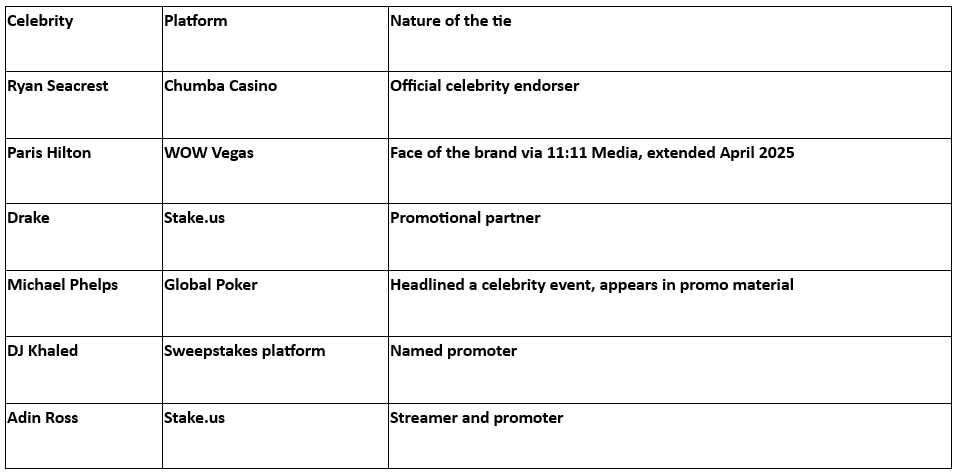
The ambassador roster at a glance
Here is where the trend stands among the names most people would recognize. Being an ambassador and being embroiled in a lawsuit are not the same thing, and the table keeps those separate on purpose.
What the list makes plain is the range. This is not a niche of gambling-world personalities. It is a daytime television host, a hotel heiress, a chart-topping rapper and an Olympic swimmer, which is precisely the reach the platforms were paying for.
How the free coins really work
The word “free” carries the marketing, so it is worth being precise about it. You genuinely can play without spending a cent. The daily login coins are real, the mail-in entry is real, and plenty of people never spend money on these apps at all.
What you are playing, though, is chance. Slots are pure chance, and no sweepstakes version changes that. There is no pattern to read, no timing to master and no skill that shifts the odds, no matter how the game is dressed up or who is holding the phone in the ad. The play-only coins cannot be cashed out for anything. The promotional coins can be redeemed for prizes, and the value of what comes back depends entirely on how the game landed, which is to say on luck.
Age limits sit at 18 or 21 depending on the platform and the state. And the redemption process is a promotion, not a payout in the way a regulated casino settles a bet. Calling it “free money” overstates it in both directions: the entry can be free, but the outcome is not owed to you, and it is not a wager the law treats like a licensed one. Understanding that split is the difference between using one of these apps as light entertainment and misreading it as a way to make cash.
The map shrank underneath the trend
Now the asterisk. The reason this is a complicated trend rather than a simple one is that the legal ground has moved hard, and it has moved in one direction.
California’s ban took effect on January 1, 2026 and removed what industry estimates put at roughly a fifth of the segment’s national revenue in a single day. Connecticut made operating one a felony-grade offense under a law enacted in June 2025. Indiana’s ban took effect on July 1, 2026, with civil penalties reaching into six figures, and major operators pulled their brands out of the state ahead of it. Maine’s ban took effect in July 2026. Oklahoma’s arrives on November 1, 2026, passed over the governor’s veto. Tennessee legislated against the category, and Louisiana and Tennessee have both pursued attorney general enforcement. Michigan, Montana, Nevada, New Jersey, New York and Washington have all acted against it, and Idaho restricts redeeming cash prizes.
One large operator alone had exited more than a dozen states and jurisdictions by late 2025 and kept withdrawing through 2026. So a glossy promo shot filmed in 2025 and still living on a feed is now, for a meaningful share of the people who see it, an ad for something they cannot legally use. Nobody had to do anything wrong for that to be true. The law simply moved faster than the content calendar, and it is still moving. Treating a sweepstakes app as a safe nationwide option is exactly the mistake the current legal picture punishes.
Why the famous deals got complicated
The shrinking map is one problem. The lawsuits are another, and they are why some of these endorsements went from routine to genuinely thorny.
A class action tied to one major platform names not just the operator but its celebrity promoters, and it does something unusual by reaching for federal racketeering claims rather than the standard advertising-disclosure questions. The Harvard Journal of Sports and Entertainment Law, writing in April 2026 about what that suit could mean for the stars attached to these apps, pointed out that endorser liability in the United States has historically turned on disclosure of the nature, source and amount of a payment. The newer theory is that a celebrity who supplies the legitimacy might be supplying more than a photo, which is a different question entirely.
None of these cases has produced a final ruling on celebrity liability, and anyone saying the law here is settled is guessing. But the mere fact that the theory is being tested changes what a famous name is signing up for. An endorsement that once looked like a simple app promotion now carries a tail of legal risk that did not exist when the trend started, and that alone has made the category harder to promote with a straight face.
How to tell if you can actually play
Strip away the star wattage and here is the practical read for anyone who has seen one of these ads.
A familiar face in the promo tells you nothing about whether the app is legal where you live. The endorsement was national. The legality is not, and it changes by legislative session. Availability now depends entirely on your state, and the trend line runs one way, toward fewer states rather than more.
If the app is available to you, the honest description is a promotional sweepstakes with slot-style games, no purchase necessary, prizes rather than winnings, and outcomes decided by chance. That is a perfectly legitimate way to spend an evening. It is casual entertainment, not an income stream. And if the app has gone dark in your state, that is not a bug and it is not the celebrity’s doing. It is a statute. The single most useful habit is to check the current status for your own state before downloading, because the map that was accurate six months ago may not be accurate today.
Frequently asked questions
Are sweepstakes casinos actually free to play?
You can play them without spending money, which is the basis of the “no purchase necessary” model. Free coins arrive through daily logins, and a promotional coin can be requested by mailing in a postcard. That said, the play-only coins have no cash value, prize redemptions depend on chance, and “free” describes the entry, not a guaranteed reward.
Are they the same thing as an online casino?
No. A licensed online casino takes real-money wagers under a state gambling license and is legal in eight states as of mid-2026. A sweepstakes casino is structured as a promotional sweepstakes with a no-purchase-necessary entry route and prize redemptions, which is why it has operated without a gambling license. Whether that structure holds up is what current lawsuits are testing.
Why are so many celebrities attached to these apps?
Because a famous face supplies the sense of legitimacy that a state license would otherwise provide, and these platforms cannot advertise as licensed operators. A trusted name makes the format feel mainstream and safe in a couple of seconds, which is exactly the reassurance the apps cannot buy any other way.
Can I play if a celebrity is still promoting it in my feed?
Not necessarily, and that is the trap. Promotional material stays online long after a platform leaves a market. California, Connecticut, Indiana, Maine and Tennessee have all banned the category, Oklahoma’s ban starts on November 1, 2026, and several other states have acted against it. Check the current legal status for your own state rather than trusting the ad.
Is playing a sweepstakes slot a matter of skill?
No. Slots are pure chance, and the sweepstakes version is no different. There is no pattern to read and no strategy that improves the odds. The outcome is decided by the game, not by the player, which is why it belongs in the entertainment column rather than the investment one.
The information provided in this article is for general informational purposes only. Gamble or play responsibly. If you or someone you know has a gambling problem, help is available. Call 1-800-GAMBLER. If you’re in the U.K. and need help with a gambling problem, call the National Gambling Helpline on 0808 8020 133 or go to gamstop.co.uk to be excluded from all U.K.-regulated gambling websites. We disclaim any liability for any loss or damage arising directly or indirectly from the use of, or reliance on, the information presented.