









Abstract
The United States has been the driving force behind the establishment of the international drug control regime and has historically served as its principal enforcer. What impact have domestic policy changes had on federal authorities in the case of the state of California? We argue that growing civil and political support for reform led to significant changes in the policy landscape, with legislation gradually turning California “green” for the recreational use of marijuana. From a methodological perspective, this study employs detailed historical process tracing to examine a single case study: the state of California. We explore how the drug issue has been perceived, how drug-related laws have been developed, and the role played by local political and social actors in shaping these changes. To understand this process, we draw on the theories of securitization and desecuritization. We ask: how is the leader of the global prohibition regime rearticulating the drug issue from a process of securitization to one of desecuritization? Our findings suggest that the securitization of drugs in California was driven primarily by governmental actors through a top-down process, whereas desecuritization has been led largely by civil society through a bottom-up dynamic.
Keywords
Drug Policy; United States; California; Cannabis Reform; Prohibitionism; Desecuritization Theory
Introduction
The year of 2021 marked the 50th anniversary of U.S. President Nixon’s declaration of the War on Drugs, which is still being fought. Although most states in the United States have enacted reforms to their cannabis laws, marijuana and marijuana-derived products remain illegal under federal law, subject only to very limited exceptions. After decades of strong U.S. engagement in promoting and enforcing global drug prohibition, a puzzle emerges: since 2012, states have increasingly regulated and legalized cannabis despite federal prohibition. The pace of change has been remarkable. By the end of 2025, cannabis had been legalized for medical use in 40 of the 50 states, and for recreational use in 24 states. Moreover, policy reform is not limited to cannabis. In 2020, voters in Oregon approved two landmark drug policy initiatives. The first decriminalized the possession of small amounts of illicit drugs, including heroin, cocaine, and methamphetamine. The second authorized the creation of a state-regulated program to license providers of psilocybin services. These developments suggest that changes in drug policy are extending beyond cannabis and challenging long-standing assumptions underlying the prohibitionist framework.
Considering this shift, one might ask: how can the United States regulate drugs domestically while maintaining federal prohibition? How is prohibition being rearticulated, transforming the drug issue from securitization to desecuritization within the federal system? This article aims to understand how a powerful war discourse that has been in place for decades is gradually being challenged. Additionally, it seeks to analyze how drugs are discursively constructed and the implications of these different constructions. To address these questions, we argue that understanding when and how non-state actors from civil society are able to influence security policies — and what enables them to exert such influence — is key to explaining marijuana policy in the United States.
Using California as a case study, this article argues that the desecuritization of marijuana in the United States has largely taken place through a bottom-up process. Rather than being driven by political elites, this shift has been led by NGOs, civil society actors, and local regulators. In the specific case of California, we contend that the reframing of cannabis — from a security threat to a matter of public policy — emerged primarily in response to popular demand, challenging the traditional, top-down securitization narrative. However, both the process of securitization and its reversal through desecuritization were not ipso facto transformations. Instead, they developed over several decades, progressing through multiple phases from the late 20th century into the early decades of the 21st century.
The article is divided into three sections: methodology; theoretical framework on the concepts of securitization and desecuritization; the first moment of desecuritization of marijuana in California, and the second moment of desecuritization in that state.
Methodology
The way we methodologically approach this study is by adopting a qualitative case study design, employing process tracing as its primary analytical strategy. Here we assume the definition that process tracing is “detailed examination of an aspect of a historical episode to develop or test explanations that may be generalizable to other events” (George and Bennet 2005, 5). Moreover, process tracing enables a systematic examination of failed securitization efforts in California, helping to explain why certain attempts to frame marijuana as a security threat stalled, while others gained traction, making this approach particularly well suited to the case analyzed in this study.
The state of California was selected because its political and socio-cultural context places it at the center of U.S. drug policy debates. The state has a large Latino population and shares a border with Mexico, a country that U.S. drug discourse has long portrayed as a primary source of illicit drug production and trafficking. As a result, California occupies a unique position in which domestic marijuana policy is deeply entangled with racialized, border-focused, and foreign-policy-oriented understandings of drug production and control.
In this paper, we also focus specifically on the California case in order to capture the evolutionary dynamics of securitization and desecuritization over time. Using the image of a pendulum as an analytical device, we illustrate how public issues can move between the realms of security and normal politics as dominant discourses shift. In our visual analysis, the pendulum illustrates that an issue may occupy different positions at different moments (figure 3 and 4 below).
Figure 3
– Securitization Theory’s pendulum
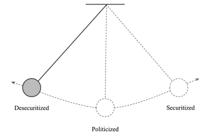
Figure 4
– Desecuritization pendulum
The empirical analysis is based on multiple qualitative data sources, as detailed below:
- Documents from California legislative sessions, including historical archives spanning several decades and covering the early stages of marijuana regulation in the state and records of legislative participation.
- Interview material from in-person semi-structured interviews with key actors in the cannabis sector, including activists, scholars and business owners, as shown in Table 1.
Securitization and Desecuritization: traditional theory and its challenges
The securitization approach is an alternative route to a wider concept of security that broadens the security agenda to include threats other than military ones. While the traditional studies’ central concern is “how we become more secure”, securitization theory asks instead “how does an issue become a security issue”. The core claim of securitization theory – that security must be understood as a “speech-act” – is not only a sociological and explanatory tenet. As a speech-act, securitization is located within the realm of political argument and discursive legitimation, and security practices are thus susceptible to criticism and transformation. The social construction of security issues (who or what is being secured, and from what) is analyzed by examining the “securitizing speech-acts” through which threats become represented and recognized (Buzan et al. 1998).
Applying the securitization theory to the USA, we argue that drugs became securitized by the speech (act) President Nixon gave in 1971, declaring The War on Drugs, with the goal of eradicating what he viewed as the growing problem of drug addiction. We identify Nixon’s discourse as a key speech act in the securitizing move that contributed to the construction of the War on Drugs. This is not to suggest that, in the USA’s case, this was the only speech act responsible for the securitization of drugs; rather, it is the one selected for the purposes of the present analysis.
The president states that “America’s public enemy number one in the United States is drug abuse. In order to fight and defeat this enemy, it is necessary to wage a new, all-out offensive”. In this sense, Buzan et al. (1998) argues that a successful speech-act is a combination of language and society, of both intrinsic features of speech and the public that authorizes and recognizes that speech. Nixon used the words “enemy”, “fight”, “defeat” and “offensive” articulating the internal conditions of a speech act. This kind of language was greatly influential in establishing the war on drugs as a global fight focused on eliminating substance abuse. In fact, global drug policy has been largely shaped by the United States’ advocacy for an “absolutist prohibition approach” (Collins 2014).
Moreover, Jutila (2006) believes that presenting an issue as an existential threat – if done successfully – means that “normal” day-to-day politics is intensified into emergency politics. This applies to Nixon’ speech and actions, particularly when he points that “in order to defeat this enemy which is causing such great concern, and correctly so, to so many American families, money will be provided to the extent that it is necessary and to the extent that it will be useful”.
Read the full paper
https://www.scielo.br/j/rbpi/a/x9LFvzMF74rr5cWXZSCphcD/?format=html&lang=en&ilang=en