








For over two decades in China, alongside their day jobs, they had cultivated peanuts, rice and sweet potatoes on two acres in an undeveloped agricultural part of the country. The crops helped keep their six children fed. But as their own parents aged and their children got older, they wanted a steadier future.
The ad, on a popular job posting site for Chinese-speaking migrant workers, didn’t specify what kind of farmwork they’d be doing, but the line about paperwork made it sound legitimate. They called the number listed in the ad, and the details sounded promising: $200 a day for eight to 10 hours of “flowering trimming,” with food and accommodation provided. A few days later, they received a text message showing the location: Farmington, a sleepy oil-and-gas town of 46,000 people on the edge of the Navajo Nation. It is the largest city in the Four Corners, the area where New Mexico, Colorado, Utah and Arizona meet, and it is one of New Mexico’s major towns.
In the first week of October, the couple began the 740-mile, nearly 12-hour drive east. As they neared Farmington, they watched the sun bear down on Ship Rock, an escarpment rising 1,400 feet above the rugged high desert, visible for 50 miles in almost every direction. Beneath the watchful gaze of the winged, cathedral-like pinnacle, the San Juan River trickled through a dry, khaki-colored valley past stony mesas and rolling hills.
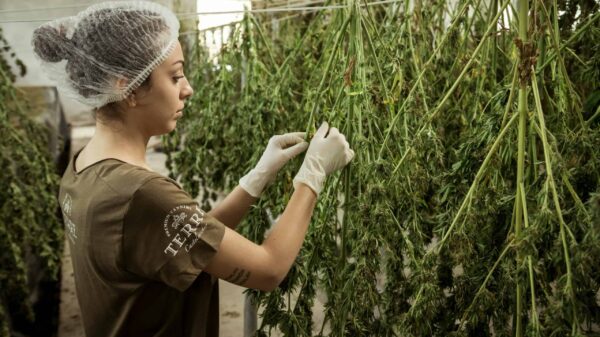
When the couple arrived at their destination, a pink, two-story motel, Mary told High Country News and The Economic Hardship Reporting Project that a middle-aged Chinese-speaking man took their car keys and confiscated their phones. Mary and her husband were put into separate rooms. Some had been converted into a makeshift processing facility, with the mattresses stashed in the bathroom and the dresser drawers emptied out. The doors were kept locked or guarded, according to legal documents, and Mark, Mary and the other workers were told to sit on an upside-down bucket beside heavy-duty black trash bags stuffed with lime-green marijuana plants.
Mary remembered the plant’s distinctive odor. The work left her nose swollen “like an elephant” and she spiked a 100-degree fever. Mary’s assignment was to cut the leaves from the plants’ buds with scissors from 7 a.m. or earlier, until 10 at night, working almost nonstop, according to legal documents. She was denied medication, and when she tried to stop work, she was forced to continue, a civil case she and others filed later stated.
Mark and Mary had unwittingly walked into the shadowy fringes of New Mexico’s brand-new legal cannabis industry — and the early days of a network that sought to use Chinese immigrants as labor on the farms that supplied the growing demand for the drug.
New Mexico, which legalized the adult use of weed in 2021, began its first licensed sales in 2022, and currently sells at least $35 million every month. Colorado and other states in the region have also legalized the plant’s use over the past decade and a half. At the same time, cannabis entrepreneurs started to see the potential for an unexpected workforce: Chinese immigrants. With youth unemployment hovering around 18% in China amid the postpandemic economic downturn, over 60,000 Chinese migrants crossed the Mexican border into the U.S. from 2021 to 2024.
When law enforcement tried to rein in illegal weed operations like this one, the workers became the focus of their efforts. Despite the efforts of social support groups, the trafficked immigrant workers ended up bearing the brunt of the punishment for the very system that exploited them.
Late on the afternoon of Oct. 8, 2020, a local passerby noticed that a man was moving marijuana plants from a vehicle into a room at the motel. A strong smell of weed was emanating from cars in the parking lot with California license plates. Shortly after that passerby dialed 911, police arrived at the motel room and knocked on the doors.
The workers opened the doors. “At first, I felt like I was finally rescued,” Mary said. But that quickly changed: The officers escorted the 16 workers out of the rooms, then instructed and gestured for them to sit or kneel on the ground, according to police dashcam video included in court filings against Mary. Some held their hands behind their heads, and as they waited over two hours to be transferred to the San Juan County Adult Detention Center, a policeman who spoke some Mandarin Chinese arrived and asked if the group knew what they were cutting. Everyone shook their heads.
After approximately five days of detention, Mary and the workers were advised that they couldn’t leave San Juan County pending trial, according to charging documents. She stared at the legal papers and tried to make sense of letters she did not understand.
A few days earlier, I’d been in Farmington, running down rumors about illegal marijuana grows involving hundreds of Chinese Americans and Chinese immigrants on the Navajo Nation in northwestern New Mexico. I collected notes on ads for investment opportunities and jobs, describing a marijuana operation on tribal land as “undoubtedly a golden opportunity.” I ran into Chinese-speaking workers in mobile home parks and half-empty strip malls in and around Farmington. Outside a motel, I stopped to talk to a Chinese-speaking man about to light a cigarette — one of Mary’s co-workers, it turned out. We stayed in touch, and after he was arrested alongside Mary, he shared his charging documents with me, clearly confused.
In the wake of the bust at the Farmington motel, law enforcement intended to shut down the entire operation. More than 1,000 Chinese Americans and Chinese immigrants were employed by the sprawling enterprise at its peak, Navajo Nation police said.
Given the high-profile nature of the bust, local law enforcement took the stance that anyone, at any level, involved in illegal cannabis growing was culpable. “You can’t say you don’t know what’s going on,” one of San Juan’s top police officers told me at the time. “We will charge them. And we will prosecute them.”
This is not a new — or uncommon — approach. Since 1979, the U.S. Drug Enforcement Administration (DEA) has offered grants to fund cannabis eradication. Success is often measured by tracking seizures and destruction, with state and local agencies presenting the number of weapons seized and the amount of product destroyed. That leads law enforcement to focus on the physical operation rather than its finances and leadership. It’s easier to find the workers, laboring in the fields and hoop houses, than it is to catch the financial backers and often-digital systems used to bring in laborers under false pretenses. The legalization and decriminalization of cannabis has also reduced interest in prosecuting those behind the business.
This means that the harshest consequences often fall on those who were least responsible. In early November 2020, a few weeks after local law enforcement targeted the Farmington motel, federal officers from the FBI and the DEA raided Diné politician and entrepreneur Dineh Benally’s farms on the Navajo Nation. They found dozens of Chinese workers, who were underdressed for the cold weather and half-asleep among the plants inside the heated hoop houses. The workers were searched and bused to a nearby high school, where the gym and classrooms were arranged for interrogation.
None of the farm’s operators or backers were arrested at the time, however. By the time law enforcement arrived, they were long gone. The charges against the 16 workers who were picked up at the motel weren’t dropped until late November, over two weeks after the bust. Yet they were clearly not the ones running the business, and at least some of them had no idea the work they engaged in was illegal.